“Our goal is to ensure that IFMIF-DONES progresses within an effective legal framework”
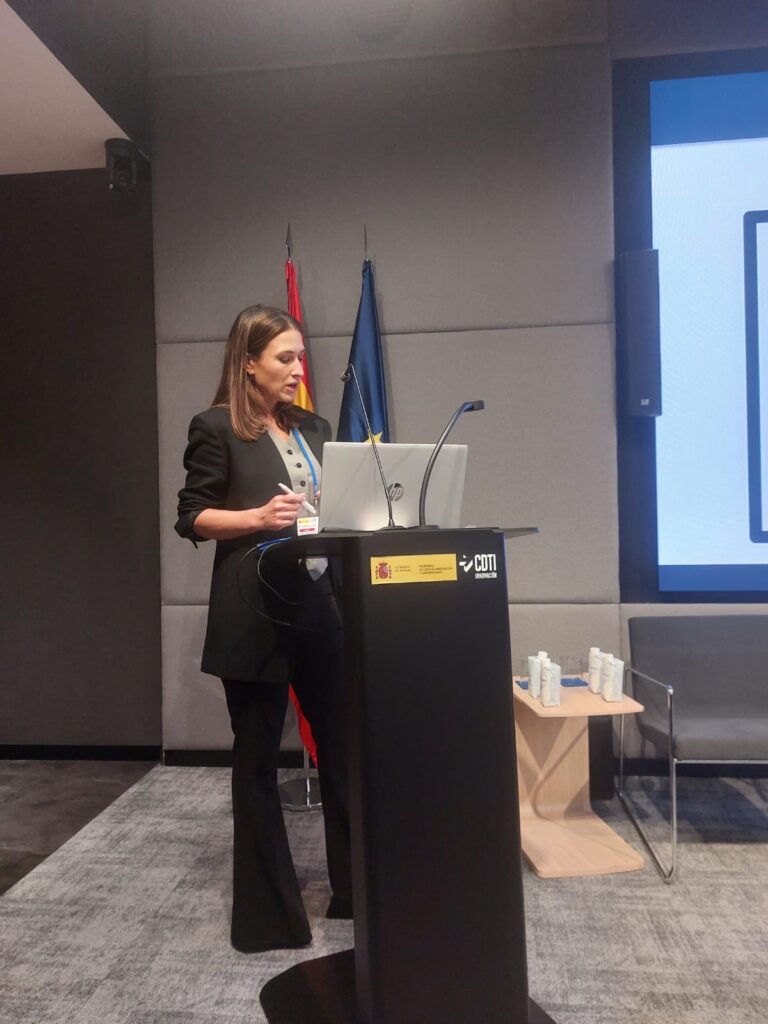
María José Gálvez (Granada, 1985) holds degrees in Business Administration and Management and Law. She serves as Head of the Legal Office of the IFMIF-DONES España Consortium.
– QUESTION (Q): Looking back, how has the Legal Office’s work evolved from the early stages of the project to the present day?
– ANSWER (A): The work of the Legal Office of the IFMIF-DONES Spain Consortium has evolved significantly alongside the growth and development of the project itself.
Initially, our work focused on establishing the legal, administrative and organisational foundations required for the Consortium to operate. As the project has progressed towards the implementation phase, the complexity and intensity of our legal work have increased considerably. Today, we deal with major public procurement procedures, highly specialised framework agreements, property-related matters, institutional agreements and obligations arising from European funding.
This evolution has also transformed our role. We have moved from a primarily advisory function focused on ensuring legal compliance to an increasingly strategic role, participating in the planning of activities, anticipating risks and proposing legal solutions that facilitate their implementation.
The Legal Office’s main objective is to ensure legal certainty while actively contributing to the effective progress of an international scientific project on the scale of IFMIF-DONES, ensuring that it advances efficiently within the applicable legal framework.
– Q: IFMIF-DONES is a unique project with a strong international dimension. What have been the main legal challenges in establishing agreements and collaborations with national and international institutions?
– A: One of the main challenges has been to establish and provide a sound legal framework for the extensive network of institutional relationships that has developed around the project, both nationally and internationally.
Over the years, the Consortium has promoted and formalised numerous agreements, cooperation arrangements and protocols with public administrations, universities, research centres and other national and international institutions. These have been essential to the project’s development.
For the Legal Office, this has involved substantial work in drafting, negotiating and reviewing a wide range of legal instruments, tailored to the specific circumstances of each institution and the objectives of each collaboration, while always ensuring legal certainty and clearly defining the commitments undertaken.
It is important to emphasise that this institutional cooperation is only just beginning. As IFMIF-DONES progresses, new opportunities for collaboration with public and private entities, both national and international, will emerge. Negotiating and establishing the legal framework for these agreements will therefore remain one of the Legal Office’s main areas of work in the coming years.
– Q: Public procurement has been fundamental to the development of the project. What challenges has managing complex tendering procedures involved while ensuring legal certainty and transparency?
– A: One of the main challenges has been adapting public procurement procedures to the needs of a scientific and technological project as unique and complex as IFMIF-DONES, while ensuring legal certainty, transparency and open competition at all times.
Preparing and managing large-scale tenders, particularly through framework agreements and contracts requiring a high degree of technical specialisation, has involved considerable planning, legal analysis and ongoing coordination with the technical teams.
We have also had to design contractual solutions capable of addressing the project’s specific requirements, anticipating potential risks and ensuring compliance with public procurement regulations.
Our main challenge in this area, both to date and going forward, has been to translate highly specialised scientific and technological needs into legally robust, transparent and efficient procurement procedures that allow the project to progress with all the necessary safeguards in place.
– Q: Behind every agreement or procedure, there is usually intensive coordination between teams. How would you describe the Legal Office’s collaboration with the organisation’s different departments in making the project’s progress possible?
– A: The Legal Office works closely, continuously and across all areas of the Consortium, since virtually every significant project activity has a legal dimension to some extent.
Our work involves close coordination with the technical, financial, administrative and management teams, with the aim of becoming involved from the earliest stages of each activity. This allows us to anticipate potential difficulties, identify risks and provide legal solutions tailored to each department’s actual needs.
We believe that the Legal Office should not simply review procedures once they have been defined, but should support teams throughout their planning and implementation, facilitating decision-making and providing legal certainty. Our philosophy is to work as a team towards a common goal: enabling the project to progress efficiently, in a coordinated manner and with all the necessary safeguards.
– Q: Over the years, the project has received support from numerous institutions. What role has the State Attorney’s Office played, and how has its advice contributed to the success and legal soundness of complex initiatives such as IFMIF-DONES?
– A: Since its inception, the IFMIF-DONES Spain Consortium has received significant institutional support, both nationally and internationally, which has been essential.
In this regard, particular mention should be made of the support and cooperation of the European Commission, the Spanish Ministry of Science, Innovation and Universities, and the Regional Government of Andalusia. Their commitment to the project has been crucial, and their collaboration has enabled us to make progress on complex issues.
Within this framework of institutional support, the State Attorney’s Office deserves special recognition, as it has become a key ally for the project. Through the legal assistance agreement signed with the Consortium, we benefit from its specialised advice on particularly important matters, including public procurement, institutional agreements, employment relations, the legal framework governing staff and other issues of major significance.
We must also highlight the professionalism, availability and close cooperation of the State Attorney’s Office in Granada. Its rigour and experience provide us with considerable confidence when addressing complex decisions. This collaboration is an essential safeguard and an indispensable source of support as we continue to advance the development of IFMIF-DONES.
– Q: If you had to highlight one achievement or particularly significant moment from these years of legal work, which would you choose and why?
– A: If I had to highlight one particularly significant achievement from these years, it would undoubtedly be having contributed to turning IFMIF-DONES into a reality.
It is a privilege to be part of a scientific and technological project of such significance and, on top of that, to have the immense satisfaction of contributing to it here in my own region.
I would like to express my gratitude for the trust placed in me, which has been fundamental in enabling me to take on responsibilities and approach the demands of a project of this scale with enthusiasm and commitment.
Being able to contribute, even in a small way, to the success of such an important project is one of my greatest motivations. It is what drives me every day to continue working with enthusiasm, a sense of responsibility and commitment.