The Regional Government contributes nearly €100M to the IFMIF-DONES Consortium for the construction of the particle accelerator
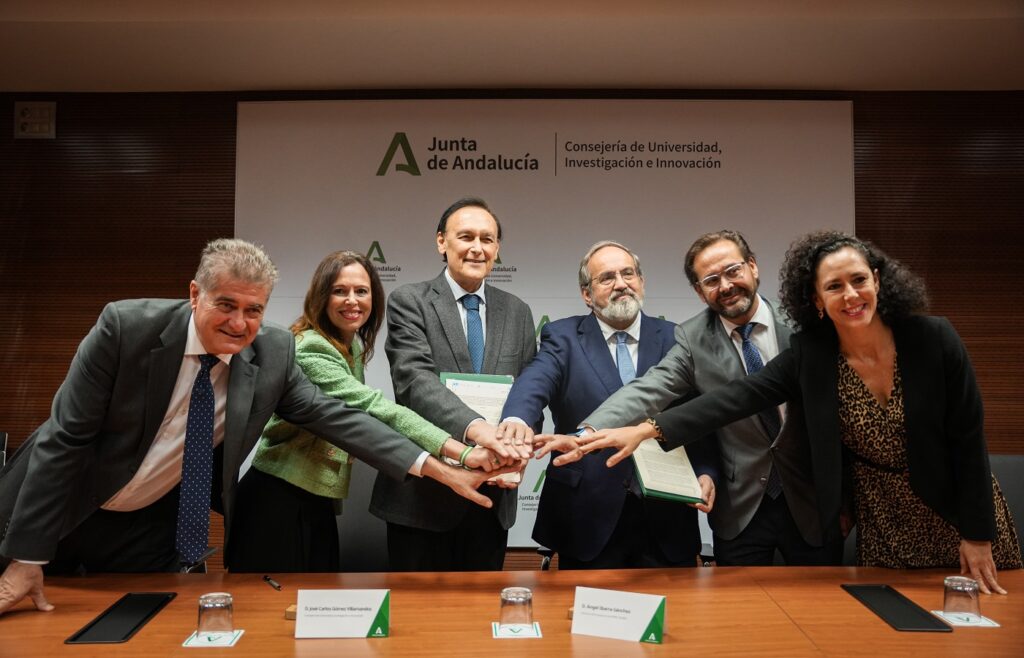
The Ministry of University, Research and Innovation and the IFMIF-DONES España Consortium have signed an agreement formalising the Regional Government of Andalusia’s grant of an exceptional subsidy of €99.87 million. This funding enables the start of construction of the particle accelerator in Escúzar (Granada), specifically the foundation works and the building of the primary structures of the scientific-technical infrastructure. The Council of Government had previously authorised the disbursement of these funds.
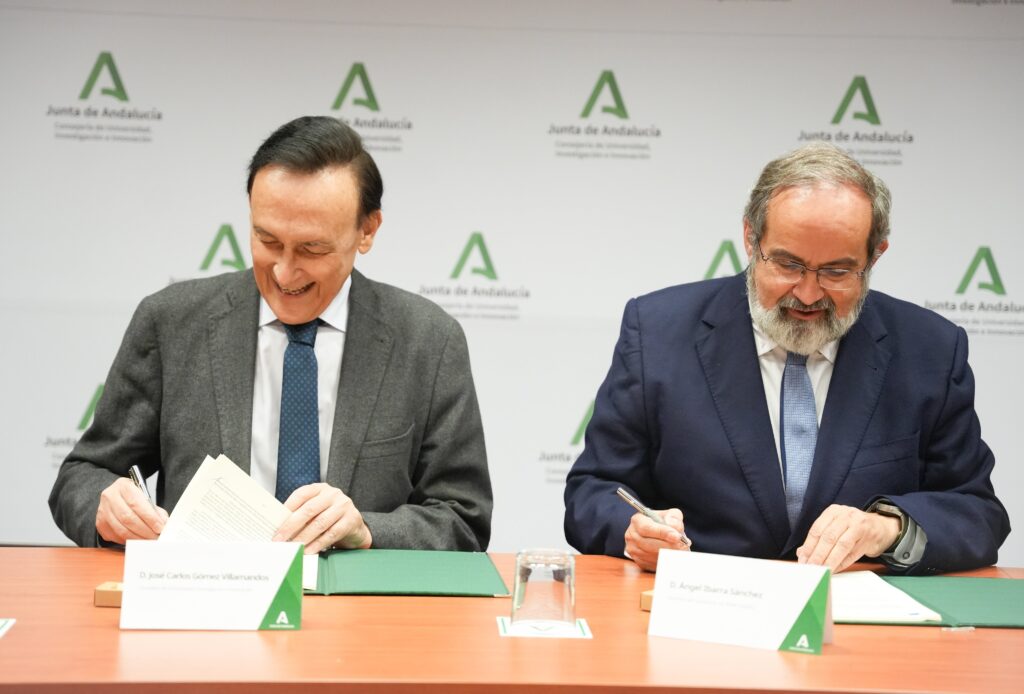
The Minister José Carlos Gómez Villamandos and the Consortium’s director, Ángel Ibarra, signed the document, in an event also attended by the Minister of Public Works, Territorial Planning and Housing, Rocío Díaz.
Gómez Villamandos stressed that “today is a very important day for Andalusian, Granadan and Spanish science, and for global science in the advancement of nuclear fusion, as the agreement is signed through which Andalusia maintains its commitment to finance 50% of the Spanish contribution to the development of IFMIF-DONES”. The Minister of University added that “the particle accelerator will place Andalusia and Granada at the forefront of research in this field of knowledge, in the pursuit of renewable energies, an area in which the region is excelling across different sectors”.
Gómez Villamandos also wished to acknowledge the work and commitment of Ángel Ibarra at the head of the Consortium, who is stepping down from his position as director due to retirement. He has served as director since the creation of this public entity four years ago and is one of the main figures responsible for the particle accelerator being installed in Escúzar.
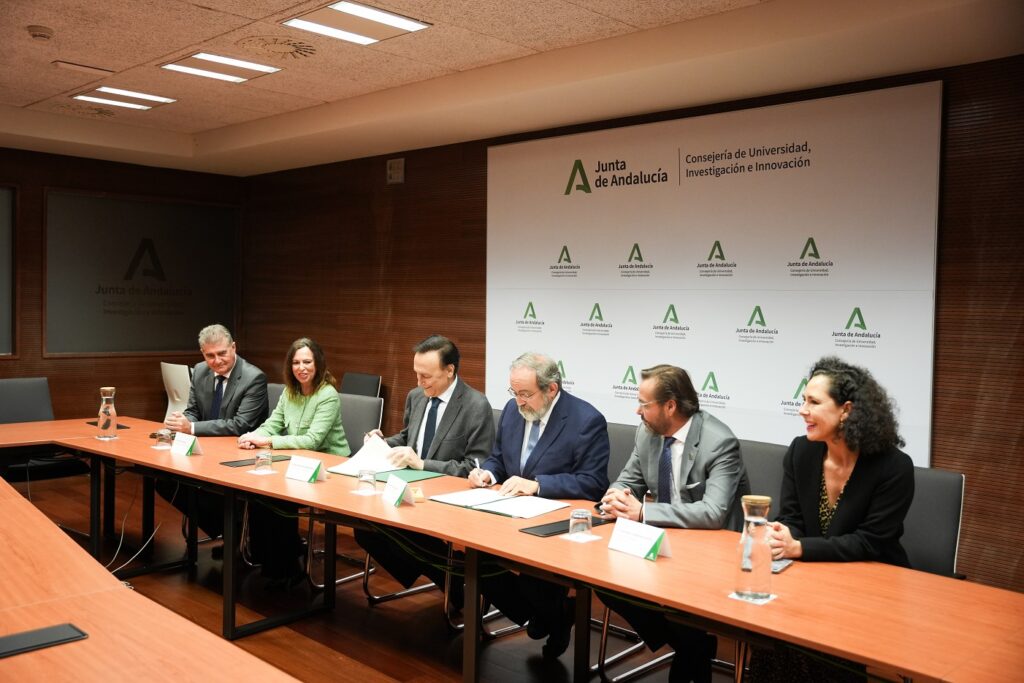
For her part, Rocío Díaz highlighted the unwavering commitment of the Regional Government of Andalusia to a project that “will place Andalusia at the forefront of scientific progress at an international level.” This commitment goes beyond this exceptional subsidy, as work has been carried out “at all levels to foster the ideal ecosystem for the arrival of the particle accelerator.” In this regard, she noted that the Ministry of Public Works has, in recent years, worked to ensure that the Citai “has access routes adapted to its new reality.” Works have therefore been carried out to widen and improve the road surface, and the design for the access route from the second ring road via the A-338 and La Malahá bypass is currently underway.
The signed agreement establishes that the amount—funded by the Andalusia ERDF Programme 2021–2027—will be transferred in full to this body, which is represented equally by the Regional Government of Andalusia and the Ministry of Science, Innovation and Universities. The financial contribution will be paid in three instalments: the first will be made immediately after the signing of the agreement, amounting to €49.93 million; the second, €24.96 million, is scheduled for 2026; and the third, for the same amount, will be paid in 2027.
The IFMIF-DONES project will be developed under a model based on in-kind contributions from participating countries and international institutions, in which each partner is responsible for building or manufacturing a part of the infrastructure, all of which will be integrated at the selected site in the Industrial and Technological City and Innovation Area (Citai) of Escúzar. Spain will undertake the first phase of construction through two separate operations: DONES BASE and DONES-TOPS. The former will be financed by a contribution from the Regional Government, while the latter will be supported by resources from the national government.
DONES BASE includes the foundations and primary structures of the building envelope. The foundation works cover all activities required to support the accelerator before envelope construction begins, which will involve excavations, backfilling, reinforcement, drainage, piling, galleries, enclosures, and auxiliary installations. The primary structures are the elements that guarantee the stability and resistance of the building and will require a series of tasks to erect functional walls and support structures, beams, columns and slabs of the envelope. According to the agreement, the maximum deadline for project completion is 31 December 2029.
This allocation of €99.87 million forms part of the €107.06 million that Andalusia will contribute to this internationally significant scientific infrastructure up to 2027, with the remaining €7.19 million—completing that amount—coming from self-financed funds previously committed by the Ministry of University. The Ministry of Science will also provide €107.06 million over the same period, resulting in a total of €214.12 million. By 2033, Spain’s contribution will rise to €422.50 million, funded 50% by each administration—just over €211 million each.
Andalusia, an international benchmark in the search for clean energy
The main mission of the particle accelerator is to test, validate and qualify the materials that will be used in future nuclear fusion power plants. The project will be developed in three stages over an estimated period of 35 years, with the construction and commissioning phase expected to last around ten years. Once completed, the operations phase will begin, lasting 20 years, from 2035 to 2055. During this period, experiments will be conducted on the irradiation of materials of interest to continuously support the design of nuclear fusion power plants. Experiments will also be carried out in various fields such as physics, medicine and industry. After operations cease, a new phase will begin—either decommissioning and dismantling, estimated to last around five years, or an extension of activity for an undetermined period.
This facility represents an opportunity to position the region as a national and international reference point for knowledge and research, particularly with regard to the pursuit of clean and unlimited energy sources. Furthermore, the synergies and knowledge transfer that will emerge from the project will strengthen the business fabric of Granada and Andalusia, enabling the application of new technological developments in other areas such as basic physics, medicine, astrophysics and even industry.
The accelerator will have a multiplier effect on both the economic development of the province of Granada and the region, as well as on its business and technological ecosystem. At the national level, it is estimated that the production of goods and services will increase by €6.133 billion (79% of the total generated by the project), raising GVA by €2.752 billion, with a projected regional increase of €687 million.
Beyond this impact, there are other equally significant effects in the field of fusion technology research, as the experience gained will lead to the creation of a materials database compiled from the information obtained in irradiation experiments.
In the environmental sphere, the project will contribute to scientific progress related to sustainable development. In addition, this facility will enable the region to lead a new energy model in the face of the current climate crisis, as nuclear fusion is a clean, safe, sustainable and inexhaustible energy source capable of producing sufficiently high quantities to meet the needs of large population centres.
With respect to human capital, the project will enhance the career prospects of Andalusian researchers and improve the training and experience of postgraduate students pursuing doctoral theses in fusion at the University of Granada and other academic institutions in the region.
* Text and photos: Ministry of University, Research and Innovation of the Regional Government of Andalusia