‘Women in DONES’ interviews… Kristina Tomić
Posted on |
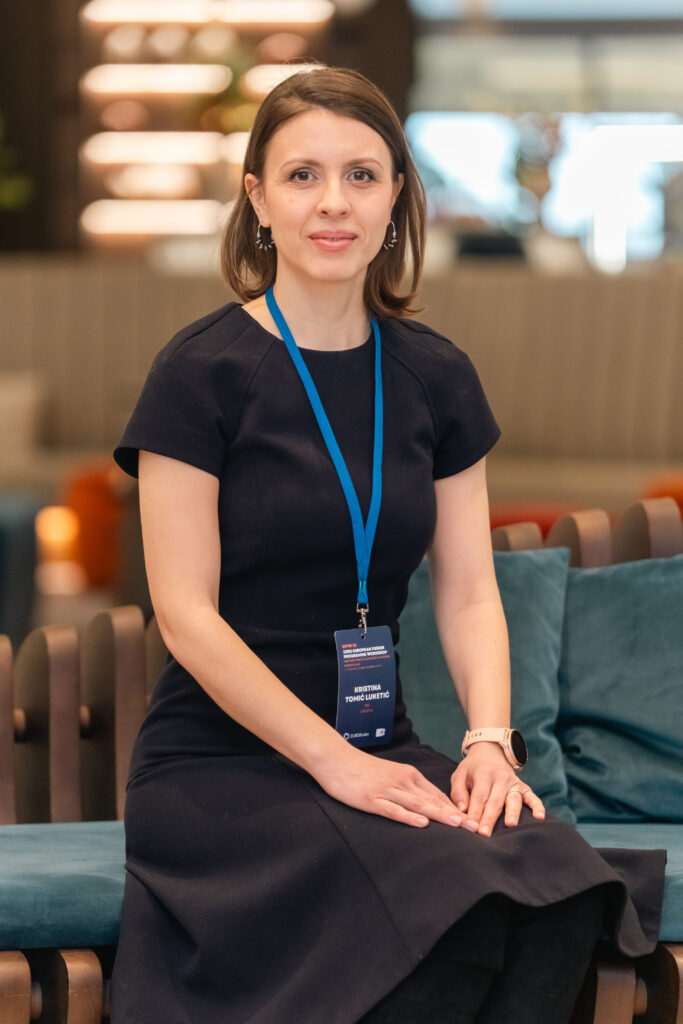
Today we speak with Kristina Tomić, who works at the Ruđer Bošković Institute (RBI). RBI is Croatia’s official implementing agency for the DONES project. Together with the Institute of Physics and the Faculty of Mechanical Engineering and Shipbuilding, it forms part of the DONES.HR consortium, which is working intensively on Croatia’s contribution to sustainable fusion energy.
QUESTION (Q). What is your current position, and how did you get there (education and academic/professional background)?
ANSWER (A): I currently serve as a postdoctoral researcher at Ruđer Bošković Institute in the field of physics – ion beam interactions, contributing to the DONES project. My academic journey began with a degree in physics and chemistry, followed by a PhD in condensed matter physics with focus on materials modification by ion beams. So far, I have gained experience through research and international collaborations, which eventually led me to join this ambitious European initiative. My path has been shaped by curiosity, persistence (I would say this has proven to be the most important thing), and the belief that science can drive meaningful change. The thought of leaving the future generations a valuable legacy is what kept me in academia after my doctoral degree.
Q. Have you faced any difficulties, injustices, or obstacles in your career due to being a woman?
A. Like all people working in STEM, I have faced challenges. However, I cannot say they were rooted in the fact that I am a woman. As far as gender bias goes, I am happy to share that I have never once felt small or dismissed, nor have I ever been asked about private decisions or family matters. In my current team, we deeply respect one another, and that culture of mutual support has been invaluable. Of course, difficulties can arise in any career, but previous experiences have taught me resilience, self‑confidence, and the importance of speaking up when needed.
Q. How would you describe the current landscape for women in the scientific and technological fields?
A: The landscape is evolving. Today, there are a lot of opportunities, mentorship programs, and institutional efforts to promote gender equality and to introduce girls to STEM from a young age. For now, women remain underrepresented in physics and engineering, particularly in leadership roles, but this is changing. Progress is visible; however, these efforts must be maintained to ensure equal recognition and advancement. Encouragingly, initiatives across Europe and globally are helping to close this gap, and projects DONES are increasingly welcoming diverse perspectives.
Q. How was the collaborative process that led to the creation of IFMIF-DONES between Croatia and Spain?
A. The collaboration between Croatia and Spain has been a remarkable example of science diplomacy. The facility will be built in Escúzar, Spain, but Croatia is a partner and plays a vital role in research & development, training, and governance. The process was highly collaborative, involving scientists and ministries of science. The signing of the Memorandum of Understanding in 2022, attended by leaders from both countries, symbolized the start of the shared commitment of Spain and Croatia for advancement of fusion energy. This partnership demonstrates how nations can unite around a common scientific vision.
Q. What message would you like to share with future women researchers?
A. To future women researchers, I would say:
- Stay inspired – you are doing great things. Remember that your work contributes to solving global challenges (e.g. clean energy).
- Believe in yourself and trust your expertise.
- Challenge the barriers. If we do not push for change, we’ll have to settle for what may be inadequate.
- Peer support and mentoring can fuel our imaginations and open new opportunities.
- Don’t give up when it’s hard. What is often seen after a significant breakthrough is just the tip of the iceberg, the unseen effort beneath it is what makes success possible.